Unified Leadership Asset Guide
Unified Leadership
Goal of Unified Leadership
Unified Leadership Two-Part Education Series
Core Messaging
Overview of Unified Leadership
Theory of Change
Unified Leadership and Athlete Leadership as Complementing Initiatives
- Overview of Unified Leadership
- Value Proposition Menu
- Impact Evaluation Data
- Latest Employment Data
- Unified Leadership Pitch Deck
Develops leaders in workplaces by fostering inclusive cultures that promote employee wellness, respect, and growth. We equip companies with tools and development opportunities to become better organizations, making leadership well-rounded and impactful.
Unified and Athlete Leadership are two sides of the same coin, together creating inclusive environments where everyone’s leadership potential is realized.
Co-developed and co-delivered by people with and without intellectual and developmental disabilities (IDD), Special Olympics Unified Leadership sessions leverage more than 55 years of experience cultivating inclusion in sport to deliver game-changing strategies that prepare people without IDD to transform their communities and workplaces to be more inclusive, so that people with IDD have opportunities to make meaningful contributions and thrive.
Unified Leadership is an essential initiative in achieving the fourth quality outcome in Special Olympics International’s Global Strategic Plan: growing the number of inclusive organizations.
The term “Unified Leadership” is used to describe many different things within Special Olympics.
- The term can be used to describe an approach or a way of operating that Special Olympics, itself, must embody to be an athlete-led movement. That means that both people with and without IDD must lead Special Olympics together.
- Unified Leadership may also be confused with inclusive youth leadership. Both initiatives teach people without IDD important lessons about how to lead and work inclusively of people with IDD. However, inclusive youth leadership is an initiative within Unified Champion Schools and has a youth audience of people with and without IDD. Unified Leadership’s audience is adults without IDD.
- Finally, Unified Leadership principles and concepts may be taught to leaders within Special Olympics International and Special Olympics Programs, through programs like Leadership Academy, but that education may be slightly different than what we offer to corporate partners.
Unified Leadership can also sometimes be confused with Athlete Leadership. These two initiatives are related, but they are distinct. Later in the document, you will read how Unified Leadership and Athlete Leadership can be leveraged as complementing initiatives in discussions with existing or potential funders.
In this document, we want to focus your attention on one particular use of Unified Leadership: a series of two educational sessions that are delivered to Special Olympics corporate partners for a donation. The two sessions are “Unified Leadership: Warm-up” and “Unified Leadership: Kickoff.” These are delivered to adults without IDD. These sessions can be used to meet corporations’ goals related to diversity, equity, and inclusion or other corporate social responsibility objectives.
This section provides information and language that you can use when describing Unified Leadership to funders. This is also language that can be copied and pasted into grant applications or other writing related to Unified Leadership. Not all of the information provided below needs to be used for all development opportunities. Rather, it is included so that you have it for a variety of opportunities.
Individuals with intellectual and developmental disabilities (IDD) encounter daily barriers that limit their full participation in the communities where they live and work; a reflection of other's perceptions about the capabilities of people with IDD, not their true capabilities.
Special Olympics addresses this challenge through a two-part educational series called "Unified Leadership" that builds understanding of IDD and equips participants with simple, practical actions they can take to support inclusion. The sessions invite individuals to reflect and learn so that they can act in ways that are more inclusive of those with IDD. By shifting mindsets and reducing stigma, the sessions help transform how people without IDD understand and engage with those who have IDD.
What can you expect?
- Learn more about the work of Special Olympics
- Stories and perspectives directly from people with IDD
- Simple, practical actions to shift limiting mindsets and support inclusion of people with IDD
- Strengthen your ability to see the dignity in all people, practice empathy and perspective taking, and acting with courage to support inclusion of people with IDD
- References to podcasts, books, and other resources to support your continued learning after the series
| Session Name | Audience | Duration | Session outcome |
| Session 1: “Unified Leadership: Warm-up” | All staff at a company can participate, but multiple delivery times may be needed to accommodate an especially large number of attendees | 60 mins, usually done virtually | Grow participants’ inclusive mindsets towards people with IDD |
| Session 2: “Unified Leadership: Kickoff” | All staff at a company can participate, but multiple delivery times may be needed to accommodate an especially large number of attendees | 90 mins, usually done virtually | Grow participants’ inclusive behaviors towards people with IDD |
Unified Leadership sessions have been strategically developed to remove a significant barrier that people with IDD face to having opportunities to make meaningful contributions to their communities and workplaces—the negative attitudes and behaviors of people without IDD.[1] Unified Leadership does this by first transforming individuals’ attitudes towards people with IDD, then by equipping individuals with specific skills and tools they can use to act inclusively, in a way that is reflective of their transformed attitude.
Combining concepts in disability studies with lived experiences of the co-facilitators with IDD, participants without IDD are able to understand disability from a strengths-based perspective and replace stigma and stereotypes with knowledge and experience.
Unified Leadership achieves this by leveraging groundbreaking research by Harvard University’s Graduate School of Education Ecological Approaches to Social Emotional Learning (EASEL) Laboratory that isolates specific components of inclusive mindsets and behaviors that are grown in each Unified Leadership session.[2]
A mindset is a set of beliefs that shape how someone makes sense of the world and oneself. Someone’s mindset influences how they move through the world, and how they think, feel, and behave in any given situation, making mindset a powerful and essential thing to target through Unified Leadership sessions.
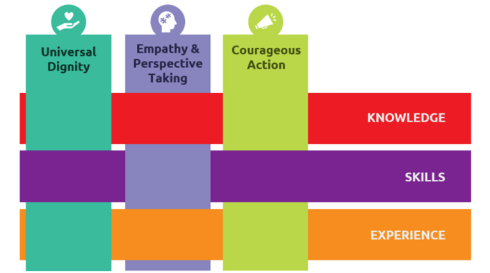
To transform mindset and behaviors, Unified Leadership sessions focus on growing knowledge, skills, and experiences in each of the isolated components of an inclusive mindset and inclusive behaviors depicted in the image: universal dignity, empathy and perspective taking, and courageous action.
By focusing on growth in each component for every aspect of Unified Leadership sessions, participants are able to grow their own inclusive mindsets and behaviors towards people with IDD.
Unified Leadership and Athlete Leadership are both initiatives that address different sides of the same problem, that people with IDD are often not given opportunities to take on meaningful roles within their communities or workplaces.[3] Athlete Leadership (programming for people with IDD) addresses this problem by providing critical, unique, and effective leadership education and experiences, which are proven to support the employability of people with IDD.[4] Through Athlete Leadership programming, Special Olympics supports the readiness of people with IDD for the workplace. Unified Leadership programming addresses this problem by providing education for people without IDD, so that companies are ready to recognize and fully leverage the great contributions that people with IDD are ready to share with them.
Presenting these two initiatives together will be especially compelling for funders who are passionate about solving big-picture issues related to employment of people with IDD or the empowerment of people with IDD to take on leadership roles in their communities more broadly.
Further, Athlete Leadership and Unified Leadership can be presented as complementing initiatives because Athlete Leadership’s Leadership and Skills Curriculum (read more here) is used to prepare people with IDD to present Unified Leadership sessions. Through Athlete Leadership programming, Special Olympics athletes, people with IDD, learn facilitation skills and technical knowledge about workplace inclusion to prepare them to deliver Unified Leadership sessions. Unified Leadership relies on Athlete Leadership programming to provide qualified, trained facilitators with IDD, who are ready to deliver Unified Leadership sessions. This may be appealing to funders who are passionate about investing in Special Olympics athletes’ leadership skills and the operations of delivering key initiatives like Unified Leadership.
“Overview of Unified Leadership”
Value Proposition Menu
Impact Evaluation Data
Latest Employment Data
Unified Leadership pitch deck (in development)
How is Unified Leadership similar and different to other similar workplace inclusion initiatives by other organizations?
- Special Olympics is focused on people with intellectual disabilities (ID), which is a distinct population even within the broader disability community. People with ID face unique obstacles to other members of the disability community.
- Broad advancements in workplace inclusion for people with disabilities have not yielded the same progress for people with ID compared to people with disabilities, broadly.
- The most recent, reliable statistics on employment of people with ID, specifically, in the United States is from 2013.
- In 2013, despite people with ID participating in the labor force and trying to get jobs at a rate that was 12.6% higher than people with disabilities, broadly, people with ID experienced an unemployment rate that was still 6.3% higher than people with disabilities, broadly (Siperstein et al., 2013) (Bureau of Labor, 2014).
- People with ID may still benefit from the workplace inclusion strategies that companies are implementing, but in order to meaningfully include people with ID, it is beneficial to have specific knowledge, skills, and experiences related to people with ID.
- If we want to drive change within the disability community towards overall justice and inclusion of people with disabilities in the workplace, initiatives must be responsive to the unique needs of people with ID, and Unified Leadership does just that.
- Unified Leadership sessions will transform participants’ mindsets and behaviors in ways that support overall inclusion of other groups of marginalized people, beyond just people with ID.
Can Special Olympics help me hire people with IDD to work at my company?
Does Special Olympics do legislative advocacy for employment of people with IDD in the United States?
- Redirect people to our theory of change. Research tells us that the greatest barriers people with IDD face to having opportunities to meaningfully contribute to their communities and workplaces are negative attitudes and behaviors of people without IDD. Unified Leadership addresses that barrier by leveraging groundbreaking research and with proven impact.
- Legislative advocacy can also be an important part of creating structural change. There are other organizations in the United States that do great and comprehensive legislative advocacy related to these topics, such as Arc of the United States, National Down Syndrome Society, National Down Syndrome Congress, and others. Because these organizations do such comprehensive legislative advocacy on these issues, Special Olympics focuses on our theory of change to transform individuals’ attitudes and behaviors.
Does Special Olympics provide job coaching to people with IDD at work?
Can Special Olympics help my company with a self-ID campaign?
- Self-identification of one’s disability status to their employer is an important issue for many companies so that they can get accurate data on how many of their employees identify as disabled.
- A key component of any self-ID campaign is ensuring that the culture of the company is one that makes its employees feel safe disclosing their disability status without fear of ridicule, stereotyping, bias, or other negative consequences. Special Olympics Unified Leadership is a proven strategy to drive cultural change in companies so that individuals are able to understand disability from a strengths-based perspective and replace stereotypes and stigma with knowledge and experience.
- [1] Kulkarni et al. (2014).
-
[2] Shriver, T., Jones S. & Jodl J. (2023).
Inclusive Mindsets and Behaviors: A Framework for Defining, Understanding, Teaching, and Fostering Inclusion (Report No. 109). Special Olympics Global Center for Inclusion in Education. Global Center Research Brief 109 Easy Read (PDF)
-
[3] Klisz, Tori A., "Disability and access: Leadership opportunities for students with disabilities in high school" (2014).
Senior Honors Theses & Projects. 389. https://commons.emich.edu/honors/389
-
[4] Van Hoofstadt, A., Bastien, T., Low, S., Vergunst, R., & Cambré, B. (2022).
The Impact of the Athlete Leadership Training on Special Olympics Athletes (Research Report). Antwerp Management School in cooperation with University of Cape Town and Special Olympics Asia.